For a long time, Guillaume Sorel’s work had already been extensively archived, documented, and organized. But, as with many artists, the information remained scattered across images, memories, and documents. With Art2App, he was finally able to give the whole thing a clearer, smoother, and more lasting form.
An Abundant Body of Work, Scattered Documentation
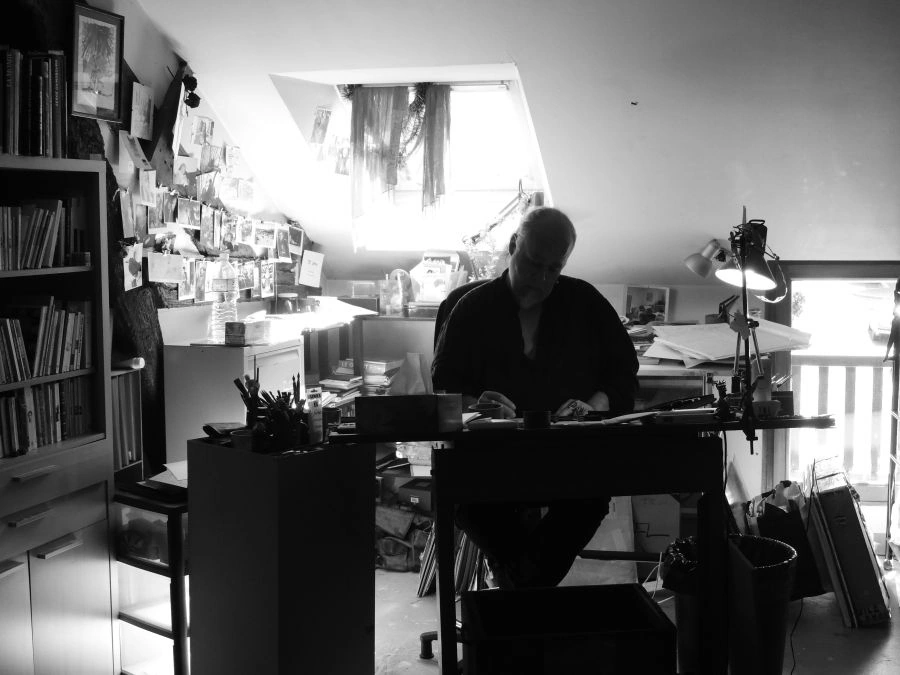
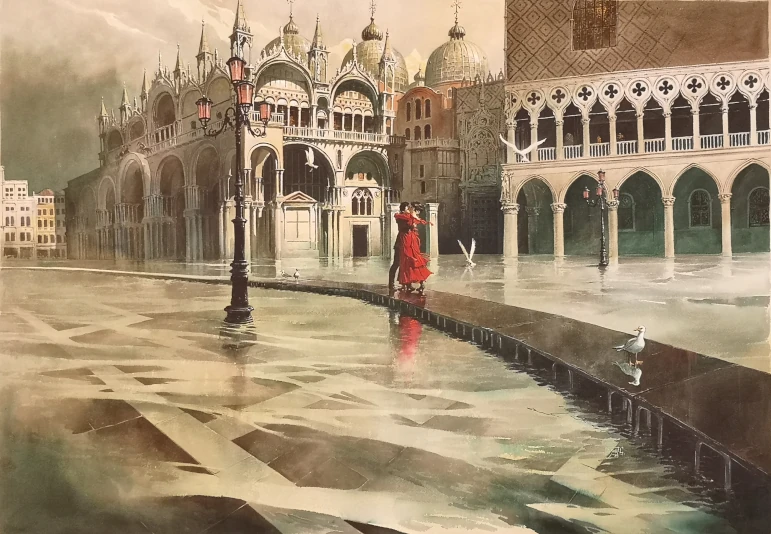
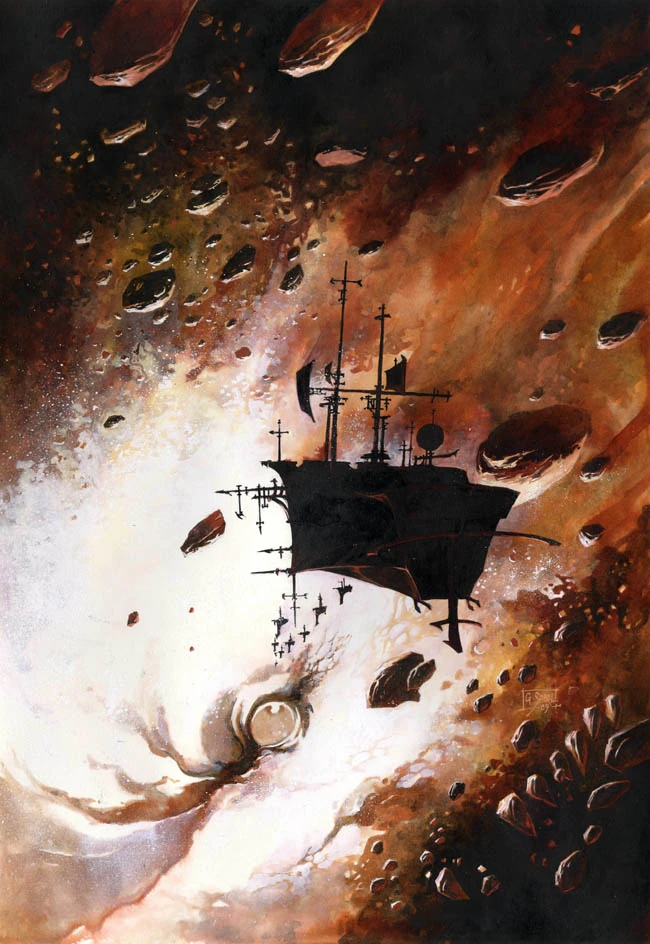
Since the 1980s, Guillaume Sorel has built a singular body of work, instantly recognizable at the intersection of comics, illustration, and painting. Trained at the École des Beaux-Arts in Paris, he published his first comic book in the early 1990s after first developing work in role-playing games. He then went on over the decades to create a dense creative universe made up of graphic novels, original pages, covers, posters, illustrated books, and more personal work.
Over time, thousands of pages, illustrations, and images accumulated. It is a considerable body of work, but never just an inventory: every piece has its context, its destination, and its history.
For a long time, Guillaume Sorel had already begun organizing all of this. “I had an Excel document that had been created about ten years ago,” he says. “I also had visuals in different files.” But he very quickly identified the real issue: “Everything was a bit scattered,” and above all, “none of it was actually connected.” The challenge isn't simply knowing the works exist, but being able to locate them, document them, place them in context, use them, and pass them on without having to reconstruct everything each time. Some information already exists, but it hasn't yet found its place in a system that's structured enough, visual enough, and simple enough to maintain over time.
Regaining an Overall View
This kind of organization works for a while. It can even hold up for years. But once the volume becomes too great, it starts slowing everything down. It is not necessarily a lack of archives; it is a lack of one place where everything truly comes together.
That is precisely why the need to catalog became clearer: to regain a complete picture. “I didn’t just want to know which works had been produced. I wanted to know where they are and what they were intended for.” In other words, he was not simply trying to list pieces, but to build a true overall view: a space where works, images, contexts, locations, exhibitions, and useful information could exist together.
A Choice Guided by Trust and Ease of Use
The choice of Art2App was not based on an abstract promise. It took shape gradually, through personal research and then within a context of trust. His gallerist, a long-time user, first told him about it and then showed him the tool on a tablet during an exhibition.
“The smoothness of it” struck him immediately. What he saw at that moment was not just a piece of software. It was a way of accessing the works simply, navigating without friction, and sensing that the tool could genuinely fit into everyday life. And above all, there was the recommendation coming from professionals he has worked with for a long time. “I’m more inclined to trust people I’ve been working with for quite some time,” he says. “The fact that they’re satisfied with it is, I think, the best advertisement there is.”
A Transition Without Starting From Scratch
The transition itself was not abrupt. “I’d say it was more of a very smooth continuation.” Thanks to the integration of his existing Excel file, there was no need to start everything over from the beginning. “I wasn’t starting from zero. It was very reassuring to see that a good portion of the information was already there.”
From there, the work could move forward gradually: correcting, completing, adding images, and improving the documentation. “When you’re getting comfortable with the tool, not starting from nothing made things much easier.” From that point on, the tool began to find its place in day-to-day life. “Today, it’s really much smoother,” says Guillaume Sorel. “Things can be done almost in real time. As soon as I have the information, I can put everything straight into the tool.” The documentation builds up step by step, which makes it possible to move forward more calmly and avoid backlog.
A Simpler, More Visual, More Coherent Way of Working
He also emphasizes the interface: “It’s quite fluid, it’s pleasant to use.” The word comes up often: pleasant. And for a cataloging tool, that is not trivial. “It allows you to focus fully on the content without being held back by technical constraints.”
That quality of use changes a great deal, and this sense of ownership also comes through the visual experience. “The fact that you can integrate images makes the tool very visual and very enjoyable to use.” For an artist, that dimension is essential. The image is not an extra; it is part of how you find things again, compare them, revisit them, and sometimes even rediscover your own work.
Some features have become especially useful to him. He first mentions the initial import, then occasional exports to “see where I am.” He also stresses record duplication when several works share some of the same information. “Being able to duplicate at least part of the information is really valuable.”
The time spent documenting is still very real, but it becomes more coherent, less repetitive, and less burdensome. Guillaume Sorel does not hide the fact that it took “a little more time” than he had imagined. But he immediately adds what justifies that investment: “Once the information is there, it’s there.” That is probably the best summary of what a good cataloging tool really represents: not a magic time-saver, but lasting stability.
Cataloging to Better Read, Envision, and Pass On One’s Work
As he continued using it, the benefit grew broader than expected. Art2App no longer serves only to centralize the works. Guillaume Sorel speaks of another way of reading his own work. “It really gives you a somewhat more unified view,” he says, “a clearer, more coherent reading of the work I’ve done up to now.” Where there was once a set of separate documents, there is now a more readable body of work.
He explains that he can now think more clearly about upcoming exhibitions, based on what has or has not already been shown. He can explore themes, add keywords, and imagine new connections. “You can also search by theme.” And he adds: “Art2App makes you ask the right questions and think differently.” Cataloging then stops being an end in itself. It becomes a tool for reflection, almost a tool for projection.
In Guillaume Sorel’s case, that expanded use goes even further. He is already thinking about the possibility of a monograph. “It’s a step toward another goal,” he says. “With this tool, I think it’s still going to be simpler.” That sentence matters because it clearly shows that a good cataloging tool is not only useful for organizing the past. It also becomes editorial support, a tool for projection, and a foundation for telling the story of the work.
Guillaume Sorel also insists on a more personal but essential point: he does not want his works to become a burden for his heirs. He wants there to remain a clear, understandable, and transferable inventory, with a structure that makes it possible to know what exists and where it is. But he also puts it very aptly: this usefulness is not only about the future. “It’s also essential today, when I need to know what I have.”
This work of structuring can even bring surprises: “Since I’ve had the tool, I’ve come across completely improbable images that I rediscovered.” That is one of the most interesting effects of this kind of approach: cataloging better is not just about classifying better. It is also about knowing your own work better, finding forgotten pieces, and deepening your understanding of your own path.
A Recommendation Born from Practice
When asked what he would say to another artist still working with Excel, his answer is straightforward. Many of his peers are his age, have a substantial body of work, and sometimes do not even have a spreadsheet, only hard drives organized “in their own way.” Yet they do not always have “a complete picture of all the works they may have produced over 20, 30, or 40 years.” To younger artists, by contrast, he says: start now. “Now is the time to record, step by step, what they are creating.”
His advice is nothing theoretical. It starts from a simple observation: “We don’t all remember everything we’ve done in our lives.” Hence the importance of a tool that is simple, structuring, and transferable. “I find the tool so simple to use that it would really be a shame to go without it.” And above all, he puts very clearly what Art2App brings him at a deeper level: “What does it bring me? Real relief.” That is probably the right word to summarize his experience. The relief of having “one place that centralizes all the information,” one place where you can see the images, document them, connect them, and track them down. The relief of having “a truly comprehensive and clear picture of nearly 40 years of creative work.” And perhaps also the relief of feeling that everything that has been produced no longer depends solely on memory, personal habits, or a filing system that only the artist can decipher.
What Guillaume Sorel’s story shows is that this is not simply about cataloging works. It is about recovering a comprehensive overview, linking works to their images and their history. With the right tool, such as Art2App, an entire creative journey becomes clearer, more readable, and easier to pass on.
Discover Art2App Collection Manager
Art2App Collection Manager helps artists and collectors structure their works, images, and information in a visual, fluid, and lasting system.
Start your free trialNo credit card required • Cancel anytime